
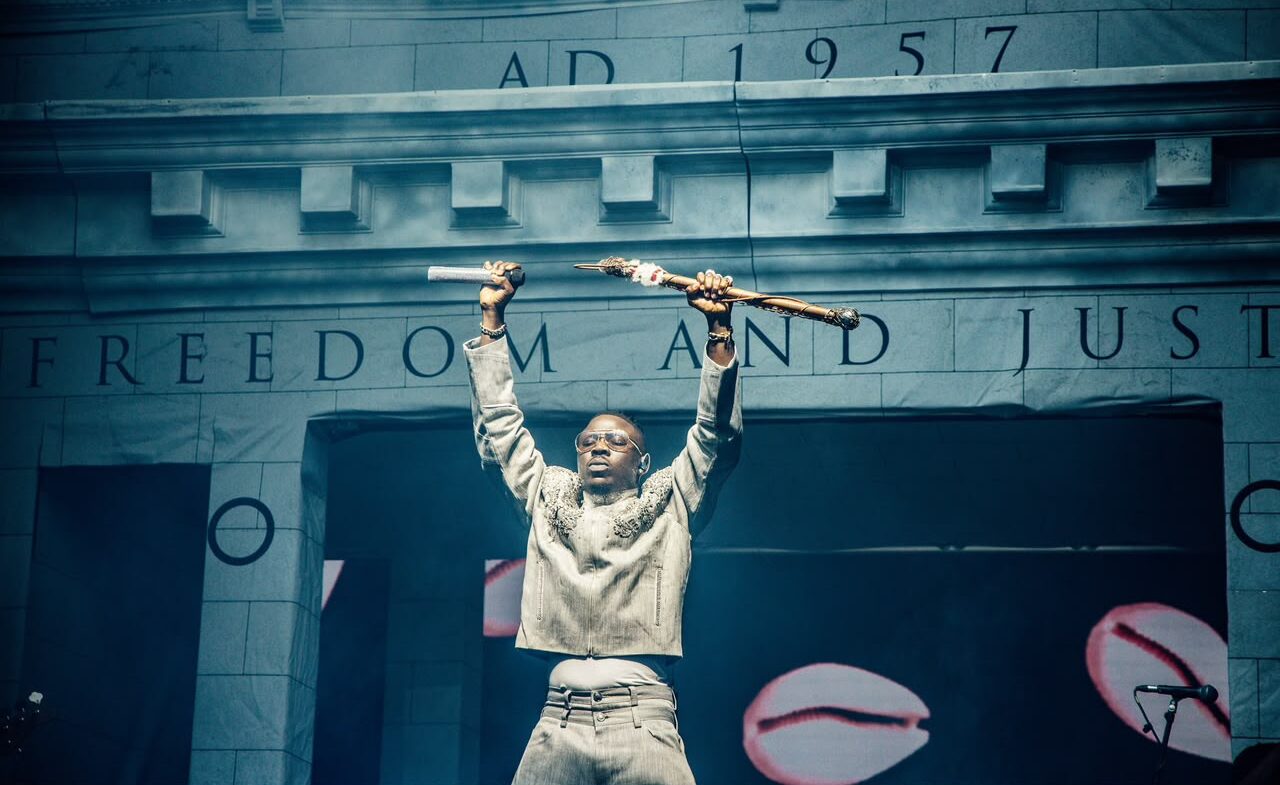
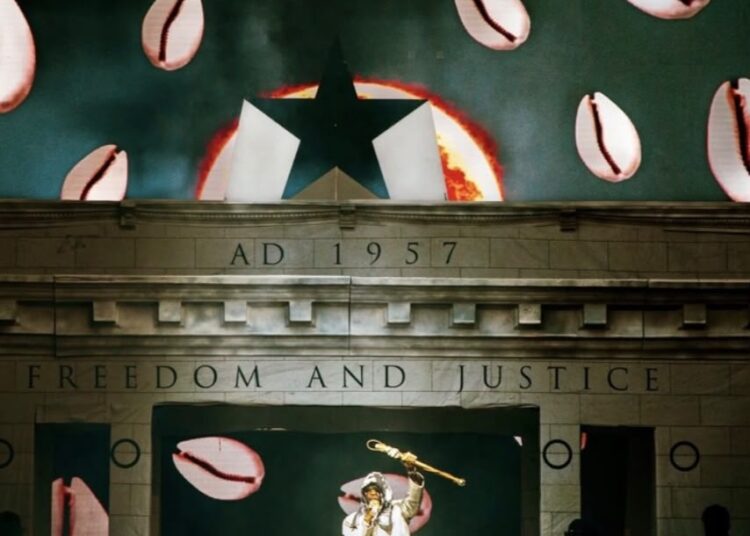
Yes, it was indeed a striking concert entrance, obviously, with people talking and all, Ghana’s Independence Arch on the screens, a burning Black Star, cowrie shells, a ceremonial staff and Stonebwoy walking through it to a roaring crowd.
But the choice of those images was not random.
BHIM Fest at London’s OVO Arena Wembley on Saturday, August 15, Stonebwoy used familiar Ghanaian symbols to tell a story about heritage, independence, identity and the journey into a global space.
The moment came on a significant night for the artiste. Stonebwoy became the first Ghanaian artiste to headline the 12,500-capacity venue, taking his BHIM Fest brand to one of the United Kingdom’s major concert spaces.
So, why the Independence Arch? Why the burning Black Star? What did the cowries represent? And why did Stonebwoy walk through the Arch rather than simply stand before it?
The Arch was more than a backdrop
The Independence Arch, carrying the familiar inscriptions “AD 1957” and “Freedom and Justice,” appeared behind Stonebwoy.
In Accra, it is a familiar national landmark. In London, it took on another layer of meaning.
The creative idea was built around Stonebwoy walking through the Arch, rather than simply standing in front of it.
That movement represented a passage from Ghana’s history into its future, a generation born after independence carrying the freedom inherited from those who fought for it into a global space.
Then came the Black Star.
It was made to burn, representing struggle, sacrifice, strength and the determination to shape what comes next.
The cowries carried the heritage
Cowries appeared repeatedly throughout, on Stonebwoy, his staff and the wider stage design.
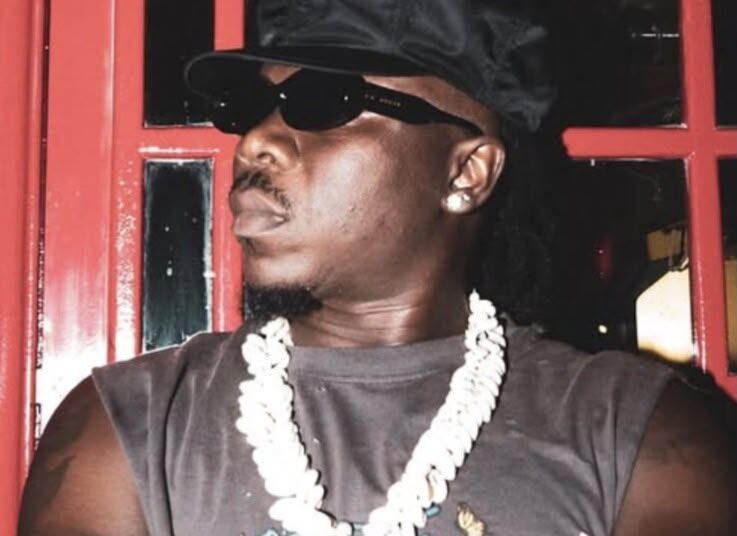
Across different African societies, cowries have historically been associated with currency, adornment, status and cultural or spiritual practices.
Within Stonebwoy’s entrance, they represented heritage, identity and inheritance.
He was not simply performing as Stonebwoy.
He was carrying pieces of his cultural identity with him.
Then there was the staff
The ceremonial staff was perhaps the most intriguing element.
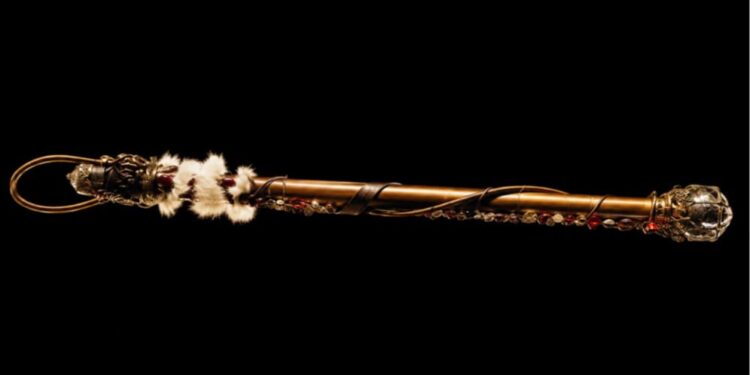
It represented authority and leadership, while its design also drew inspiration from the biblical image of Moses and his staff, a powerful symbol of liberation and the movement of an oppressed people towards freedom.
The incorporation of cowries brought that liberation imagery into an African cultural context.
The message was clear: heritage and leadership were travelling together.
It was designed like a story.
The entrance unfolded gradually.
Darkness came first, followed by shadows, cowries and the outline of the Independence Arch.
Then “AD 1957” and “FREEDOM AND JUSTICE” became visible.
The Black Star ignited.
The staff emerged.
And finally, Stonebwoy appeared and walked through the Arch.
The audience was introduced to the history before meeting the man carrying it.
That is what made the entrance more than stage decoration.
Ghana had arrived in London.
The symbolism became even more powerful because of where it was happening.
London was once at the centre of the colonial system under which the Gold Coast was governed. Decades after Ghana’s independence, a Ghanaian artiste was standing in one of London’s major concert venues with Ghana’s national symbols surrounding him.
And he was not alone.
BHIM Fest featured a strong Ghanaian and African line-up, including Samini, Kwabena Kwabena, Ofori Amponsah, DopeNation, Jux, Mista Silva, Mr P, Stylo G and Tiwa Savage, among others.
The night was more than a Stonebwoy concert. It was a showcase of Ghanaian and African music in a major international market.
The idea was not revenge or an attempt to rewrite history.
It was reclamation.
The Independence Arch represented where Ghana’s modern journey began.
The Black Star represented freedom and aspiration.
The cowries represented heritage.
The staff represented authority.
And Stonebwoy represented a generation carrying all of that into spaces their predecessors could only dream of entering.
That is why the entrance deserves a second look.
Because beyond the fire, the lights and the screaming crowd was a simple message:
Ghana remembers where it came from, carries its heritage proudly and is confident enough to walk into the future on its own terms.
At BHIM Fest, Stonebwoy did not leave Ghana behind when he arrived in London.
He brought Ghana with him.
WATCH THE ENTRANCE VIDEO BELOW:
STONEBWOY ENTERS at the BHIM FEST LONDON 🇬🇧#BhimFestLNDN26 pic.twitter.com/2d2abaW7k5
— BhimNatives UK 🇬🇧 (@BhimNativesUK) August 15, 2026
Explore all the juicy entertainment news you desire with GhanaWeekend on WhatsApp!
Click on the link to join the GhanaWeekend channel for curated, meaningful stories tailored just for YOU: https://whatsapp.com/channel/0029VaJ31iEDTkK8wIHNj31A