
Behringer and Akai Professional are attracting attention in the music production industry with new devices that could give musicians greater freedom to customise their equipment.
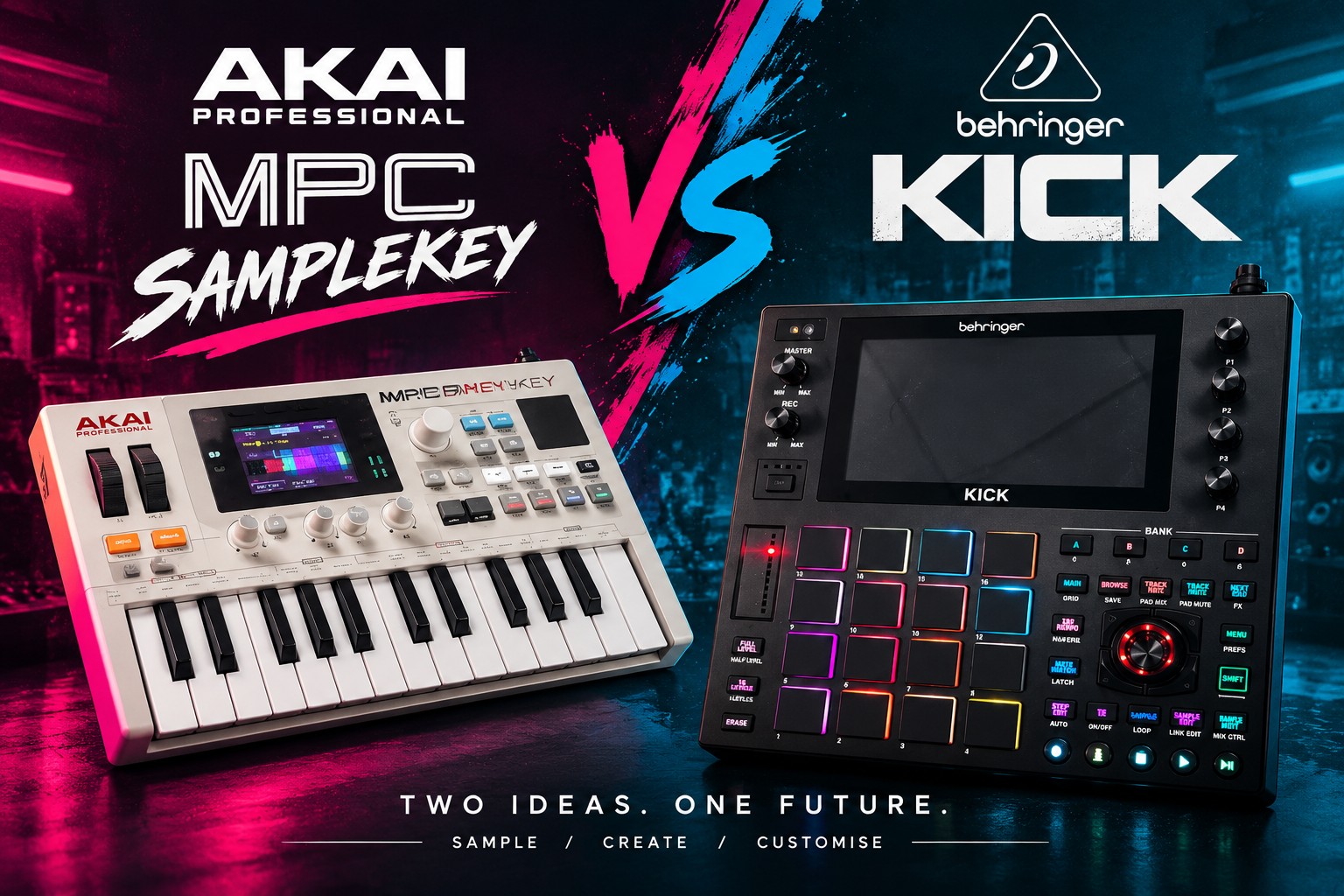
Behringer has revealed its upcoming KICK groovebox, while Akai has teased the SampleKey, a compact keyboard sampler. Both developments highlight a growing interest in open firmware and community-driven innovation.
Behringer’s KICK features a design similar to Akai’s MPC One, with a 7-inch touchscreen, 16 RGB performance pads, a sampler, step sequencer and looper. Its published specifications also list more than 300 effects, MIDI connectivity and four CV/Gate connections for use with modular equipment. The standout feature is its open-source firmware, which Behringer has made available through GitHub, allowing developers to explore the code and potentially create customised software.
Akai has responded to the growing conversation with its SampleKey teaser. The keyboard-based instrument reportedly features a two-octave keyboard, pitch and modulation wheels, and the ability to sample individual keys and create automatic key splits. Akai has also indicated that users will be able to experiment with its firmware, potentially developing new functions and sound engines.
Although the timing has fuelled speculation about competition between the companies, neither has confirmed that one announcement directly influenced the other. The devices also serve different creative purposes: Behringer’s KICK focuses on pad-based beatmaking and sequencing, while Akai’s SampleKey centres on playing and manipulating samples through a keyboard.
Open firmware could give producers more opportunities to personalise their instruments rather than depending entirely on manufacturer updates. However, the extent of these possibilities will depend on the software, available development tools and hardware limitations. Both devices still have important details to establish, including final specifications, pricing and release dates.
For musicians, the competition could ultimately be about more than hardware design or affordability. If both companies deliver on their promises, producers may gain greater control over how their instruments function and develop over time. The question is whether open-source music hardware will become a lasting industry trend or remain a feature of a few experimental products.