

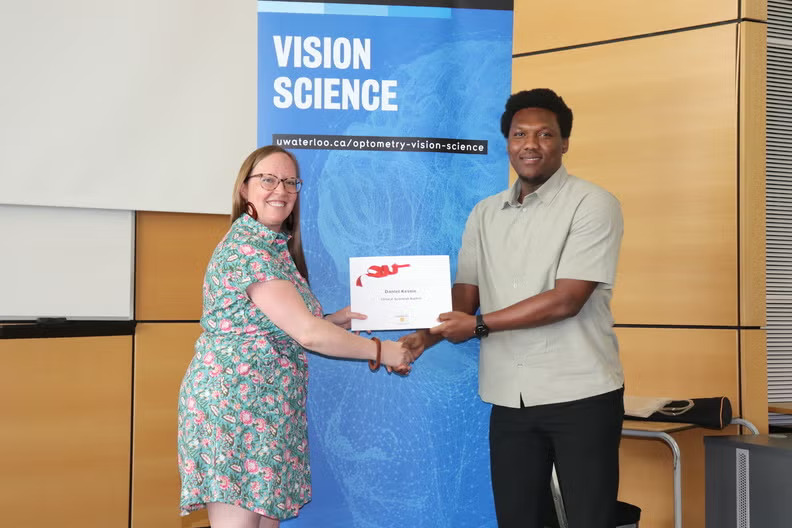
Daniel Kessie, a Ghanaian optometrist and second-year MSc student at the University of Waterloo’s School of Optometry and Vision Science, is transforming how eye diseases are diagnosed.
After earning his Doctor of Optometry from the University of Cape Coast in 2021 and practicing as a clinician for two years, Daniel’s passion for improving diagnostic tools brought him to Canada.
His innovative work on ultra high-resolution optical coherence tomography (UHR-OCT) has earned him the 2025 Clinician Scientist Graduate Award and the 2024 International Master’s Award of Excellence.
In Ghana, Daniel used optical coherence tomography (OCT), a non-invasive imaging tool that uses light to visualise eye structures, sparking his interest in enhancing its capabilities.
“I wanted to develop technology to catch eye diseases earlier,” he says. This drive led him to Dr Kostadinka Bizheva’s lab at Waterloo, where, co-supervised by Dr Alex Hui of the Centre for Ocular Research and Education, he’s pushing the boundaries of UHR-OCT.
Unlike standard OCTs, these advanced systems offer high-speed imaging and resolution so precise they can capture individual cells in the eye.
Daniel’s research targets limbal stem cell deficiency (LSCD), a rare condition that can lead to blindness if not detected early.
“LSCD is often missed until it’s advanced,” he explains. “Our UHR-OCT systems allow us to see cellular changes early, enabling non-invasive, accurate diagnoses and timely treatments to avoid surgery.”
His work could redefine clinical standards for eye care globally.
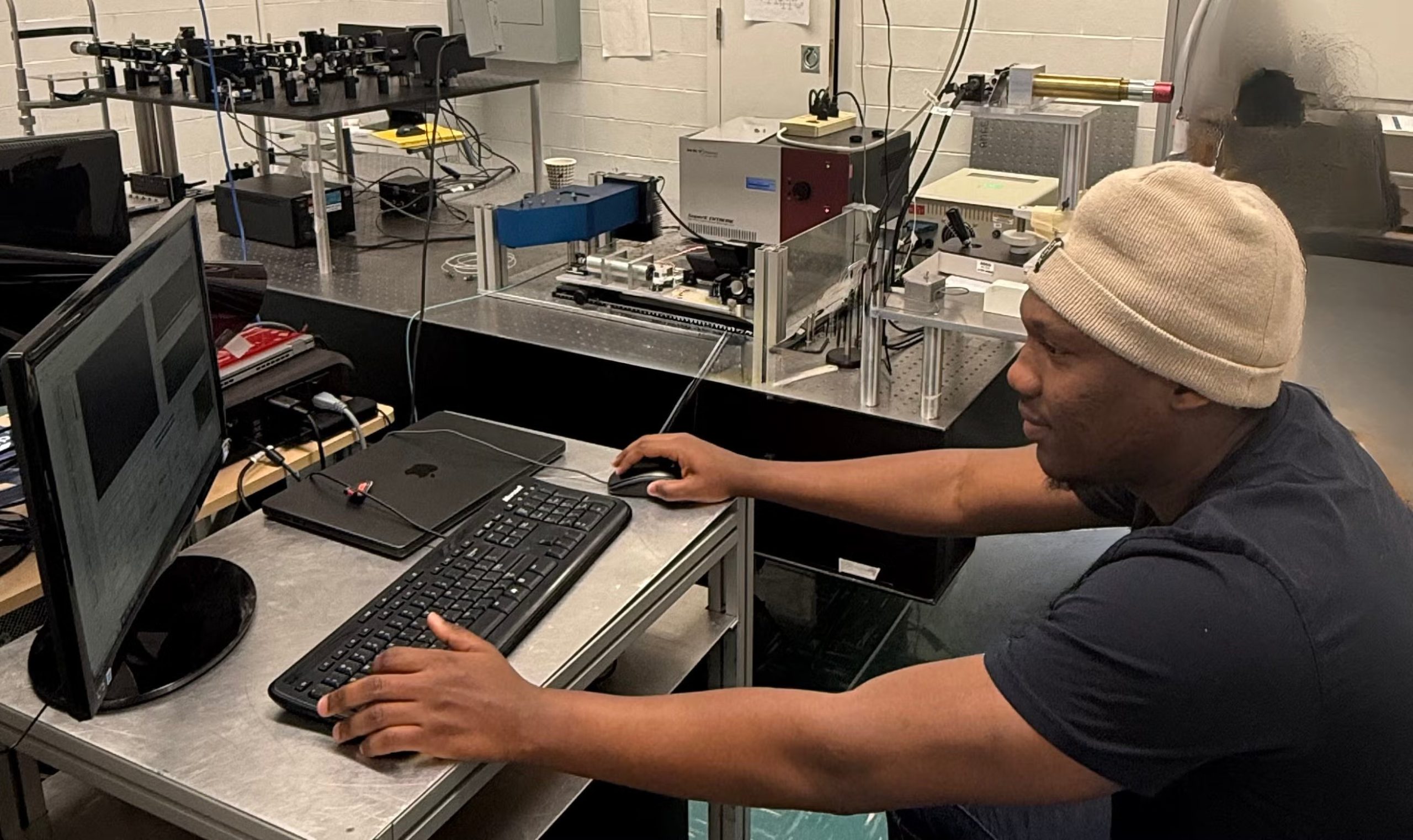
Looking ahead, Daniel aims to bring UHR-OCT to clinics worldwide, with a special focus on West Africa.
“Diagnostic tools there often use data from North American studies, which don’t always match African populations,” he notes.
“We need region-specific research to ensure precision.” He dreams of becoming a professor, blending research, clinical practice, and mentorship to train future optometrists in Africa.
Navigating graduate school wasn’t without hurdles. “Learning the physics of OCT and adjusting to Canada was tough,” Daniel admits. “But my supervisors’ support made it rewarding.”
His advice to aspiring researchers? “Find mentors who guide and inspire you, it makes all the difference.”
Through his work, Daniel Kessie is not only advancing vision science but also building a brighter future for eye care worldwide.
Read also
https://ghanaweekend.com/2025/05/27/veteran-journalist-nana-kwasi-gyan-apenteng-dies-aged-74/