

In Ghana, we have become accustomed to chastising politicians for the reckless way they spend the public purse. From luxury cars to inflated budgets, our leaders are often accused of treating state resources like their personal inheritance. Citizens shout, journalists probe, and civil society demands accountability.
But something unsettling is happening much closer to home — right here at the University of Media, Arts and Communication- Institute of Journalism (UniMAC-IJ), an institution that prides itself on training the next generation of journalists, the supposed gatekeepers of accountability. The very people who should be learning to hold leaders to task are now behaving like the same politicians they condemn.
Recent revelations about the SRC’s expenditure are nothing short of outrageous. Money that should have gone into student-centered initiatives appears to have been spent with a level of comfort and entitlement we normally associate with government appointees.
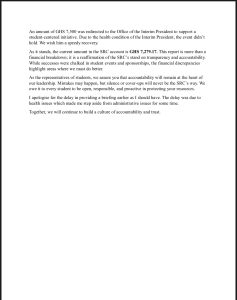
Reports from the Students’ Representative Council’s (SRC) second-semester financial briefing, presented by the current financial secretary, reveal questionable spending patterns. According to the report, ₵120,000 was spent on souvenirs, ₵35,000 on artiste night, and ₵7,500 was redirected to the office of the Interim Committee President, Bernard Afful Ansah, for an initiative that never took place—and the funds have still not been returned.
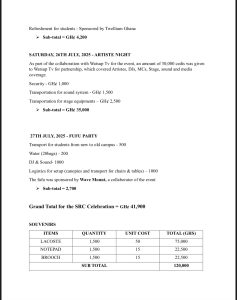
The same report showed that the SRC account had an opening balance of ₵192,227.52 at the start of the semester. This amount increased by ₵170,975.00 after the recovery of certain financial discrepancies, bringing the total to ₵363,202.52.
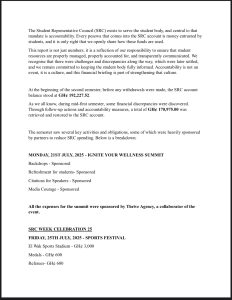
Shockingly, the SRC is exiting office with just ₵7,279.17 in its account. What makes the situation more disappointing is the absence of a proper breakdown and accountability for how such huge sums were disbursed.
And yet, just months ago, these same executives walked into our classrooms, campaigning like saints — humble, approachable, promising to serve.
This is the Ghanaian political cycle in miniature. Those who desperately seek power always wear the mask of the folk. They eat with us, laugh with us, and convince us they are different. But once they taste the perks of leadership, the mask drops. Suddenly, it is no longer about the people. It is about comfort, prestige, and self-interest.
What makes this even more painful is the setting. UniMAC-IJ is not just any university; it is the nation’s hub for training journalists — watchdogs of society. We are taught that a journalist must pursue truth, even when it is uncomfortable. We are trained to give voice to the voiceless, to fight corruption with courage, to serve the public interest above personal gain. Every lecture on ethics, every discussion on media law, every newsroom simulation emphasizes that accountability is not a suggestion — it is a duty.
These lessons are not abstract. They are the very principles we expect politicians to uphold. When we cover stories on reckless government spending, we are told to confront power with facts. When we study investigative reporting, we are reminded that public office is a public trust. When we analyze media and democracy, we are reminded that transparency is the backbone of leadership.
And yet, here at UniMAC-IJ, those values are being betrayed by the very students who should embody them. Instead of modeling the integrity we are taught daily, some of our leaders are practicing the very habits we are warned against: opaqueness, extravagance, and the betrayal of trust.
This is not simply about a few thousand cedis gone astray. It is about a culture being planted. A dangerous lesson is being rehearsed: that leadership is about gaining privilege, not service. And if this lesson is perfected within student politics, it will follow us into the national sphere, where the consequences are far more devastating.
I write this not out of bitterness but out of deep concern. We cannot allow this rot to take root in our backyard. The silence around these SRC expenditures is deafening, and as a community, we must demand explanations. If we let it slide because “it is just student politics,” we will be grooming future leaders who see public resources as spoils of war.